
Follow the Oconee County Property Owner Route
Take the question one step at a time. Oconee County Property Appraisal gives you the parcel identity and the current roll snapshot. The Clerk of Superior Court holds the recorded transfer. GIS mapping helps confirm the address truly points at the tract you mean. Every stop matters when a purchase, an estate, a boundary dispute, or a deed-fraud worry rides on the answer, so resist the urge to skip one and trust a single source.
- Normalize the situs address while preserving older city or road wording found in a deed.
- Search official Oconee QPublic and copy the owner line, mailing address, parcel code, and legal description.
- Search the newest matching transfer in GSCCCA by name or book and page.
- Confirm its grantee and legal description refer to the same Oconee County parcel.
- Resolve a trust, estate, or company name only through the proper official record.
Turn an Oconee County Address Into a Parcel Code
Do not treat the mailing city as proof of jurisdiction in Oconee County. Postal realignment shifted some deliveries between Watkinsville 30677 and Bogart 30622, and North High Shoals records may carry a Bishop or High Shoals label instead. When an exact address search misses, try the variants, but keep the original wording next to the normalized form so nothing gets lost.
Copy parcel codes exactly as they appear, spaces and suffixes included. Local examples include A 10 011 and C 02A 076. The county publishes no key for decoding the prefixes, so treat the full code as the link that joins QPublic, GIS, tax, and planning records.
Compare Oconee County Property Owner Sources
Every office runs on its own clock. The appraisal roll exists for parcel administration and taxation. The Clerk indexes a deed only once it is accepted for recording. A buyer who just recorded a deed may therefore surface in GSCCCA. The QPublic owner line can lag behind that update. Compare the dates on each record rather than deciding one office is wrong.
| Owner-finding stage | Official source | Useful result and access |
|---|---|---|
| Identify the tract | Property Appraisal and QPublic | Owner line, situs and mailing fields, parcel code, and legal description; call 706-769-3921 if blocked |
| Confirm the transfer | Clerk and GSCCCA | Grantee, grantor, instrument, date, and book/page trail; call 706-769-3940 or visit Room 208 |
| Check geography | Oconee County GIS | Polygon, RealKey, acreage, subdivision, and edit clues; GIS help is 706-310-3546 |
| Explain a named owner | Probate, court, or Georgia SOS | Estate, court-order, or entity context in its official file |
An owner of record and an occupant are not the same thing. The mailing address may point somewhere else entirely, and neither the tax roll nor a GIS map establishes who lives on the land.
Read the Oconee County Assessor Owner Line
On the assessor screen, look for the ownership line, the situs address, the mailing address, the parcel code, and the legal description. Land, building, and total fair-market value, plus assessed value, exemptions, and tax district, all help confirm the right tract is open. QPublic does not publish a fixed field order, so treat these as the fields to seek rather than a promised screen layout.
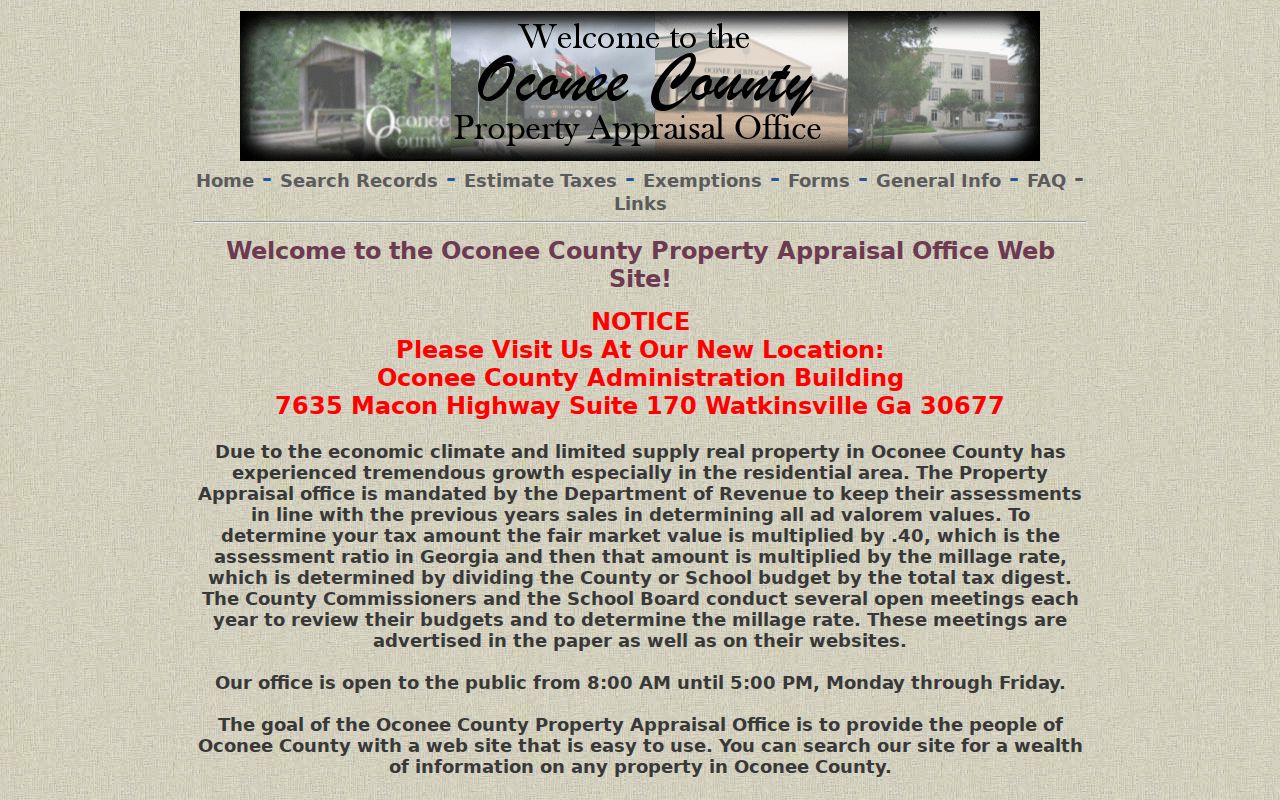
If the online viewer will not load, call or visit Property Appraisal at 7635 Macon Highway. A stale third-party listing is a weaker source than the office itself.
- Owner of record
- The person or entity named on the public parcel roll at its current update point.
- Vesting
- The manner in which an interest is held as expressed in the recorded instrument.
- Grantee
- The party receiving an interest under a deed.
- Situs versus mailing
- The parcel location compared with the destination for notices.
Confirm Who Owns Oconee County Property in the Deed
Search the GSCCCA Real Estate index with the assessor's owner name and a narrow date range. Select Oconee County before you run the search. The search screen lets you filter by party type and instrument type. You can also include neighboring counties and set a county index date. A known book and page usually beats a common-name search for precision. Match the grantee, the date, and the legal description against the parcel you identified. The statewide landing page describes coverage for all counties since 1999, with historical data being added for 1993 through 1998. The name-search screen shows a 1990 start. Because the Oconee image cutover is unclear, ask the Clerk whenever an older result or image seems doubtful. Ask sooner rather than later.
Identify Oconee County Trusts, Estates, and Companies
An owner line may name an LLC. It may also name a trust, an estate, an executor, or a life tenant. Preserve the full name and the legal capacity exactly as written. A Georgia Secretary of State filing can confirm an entity's registered identity. An Oconee Probate file can explain how an estate transferred. Neither source reveals every beneficial interest, and neither substitutes for the deed itself. Life-estate wording rewards close reading. Present use and a future interest can both carry weight. An executor's deed or a court order can also break a simple buyer-to-seller chain. Pull the underlying document before you shorten anything the index says.
Use Oconee County Mailing Data With Restraint
The mailing address helps separate same-name owners and shows where tax notices go. It proves no occupancy and grants no permission to contact anyone. Keep the lookup tied to a legitimate property purpose, such as purchase diligence, an easement question, or estate administration. You can also use it to confirm a transfer. Georgia confidentiality programs and lawful appraisal non-disclosure can shield eligible addresses. A missing or redacted field is never evidence of wrongdoing.
Escalate an Oconee County Owner Question
A screen result is fine for research. A dispute or a closing decision needs an authenticated record. The Clerk offers eCertification and counter service for real-estate documents. The county publishes no current copy price list, so request a quote instead of assuming a fee.
No online record settles the question? The Georgia Open Records Act opens a door to existing public records. Describe the parcel, the instrument, the date range, and the fields you need. The agency generally produces the record or responds with status, cost, exemptions, and timing within three business days. It does not have to create a new ownership report for you, though.
What an Oconee County Property Owner Search Cannot Tell
Knowing the owner of record settles none of the bigger questions by itself. It does not establish occupancy or clear title. It does not grant open access, fix exact boundaries, or rule out liens. The assessor roll, the deed index, and GIS each serve a narrower purpose. So does a court file. A plat does too. For a formal title conclusion, rely on certified documents and qualified legal or title help.
Lawful use. Verify important findings with the custodian, and never use a property owner search to stalk, harass, threaten, or harm anyone.
The more focused Oconee County current owner guide explains the two-clock timing problem in depth. The broad method still holds: address, parcel, owner clue, and deed confirmation.