
What Oconee County Deed Records Convey
Deeds are only part of what the Clerk of Superior Court records. Security instruments, plats, liens, and covenants sit in the same official record books. A deed names the parties, gives a recording reference, and describes the land. Read the deed type closely. It controls what interest and warranties the signer actually purports to convey.
| Deed Type | What It Does | Common Use |
|---|---|---|
| Warranty deed | Conveys the stated interest with broad warranties | Ordinary sale |
| Quitclaim deed | Conveys whatever interest the signer holds | Family transfer or correction |
| Limited warranty deed | Limits warranties to the grantor's period | Entity or commercial transfer |
| Executor or administrator deed | Transfers estate property under authority | Probate administration |
| Tax deed | Records a transfer after an authorized tax sale | Delinquent-tax process |
One caution deserves its own line. A security deed or lien encumbers property; it does not transfer ownership. Pull the later releases and satisfactions too, since an original filing can stay visible in the index long after the debt is resolved.
Walk the Oconee Grantor-Grantee Index
The GSCCCA Real Estate Search opens three routes: by name, by book and page, or by property. Start at the most recent acquisition and work backward. At each step, check the legal description against the same tract so the chain stays honest.
- Find the current listed owner as grantee and select the newest matching deed.
- Record its grantor, date, book/page and description.
- Search that grantor as grantee in an earlier period.
- Repeat, then move to deed books or microfilm beyond online coverage.
- Grantor
- The party transferring the stated interest.
- Grantee
- The party receiving that interest.
- Chain of title
- The linked sequence of instruments affecting one tract.
- Book/page or instrument number
- The recording reference used to retrieve a filing.
Obtain an Oconee County Deed Copy
Use an available index image, visit or call the Clerk at 23 North Main Street, Room 208, Watkinsville, 706-769-3940, or use eCertification. That service requires an account, county and document selection, clerk processing and post-processing payment before delivery of a secured PDF. The research did not establish a current local fee schedule, so confirm the price and any mail procedure directly.
Recorded, not guaranteed. Oconee County deed records show filed instruments, not a title opinion. Unrecorded interests and competing claims can require professional examination.
Search Oconee Deeds by Name, Book or Property
The statewide recorder interface splits searching into three separate routes. Pick the one that matches the clue you already hold.
| GSCCCA mode | Visible controls | Best use |
|---|---|---|
| Name | Party type, instrument, county, name, dates, neighboring counties | Acquisitions and transfers |
| Book/page | County, good-from/thru, book and page | Known citation |
| Property | Subdivision and optional dates | Subdivision-indexed filings |
The GSCCCA property-search screen illustrates the subdivision-based route available beside name and book/page searches.
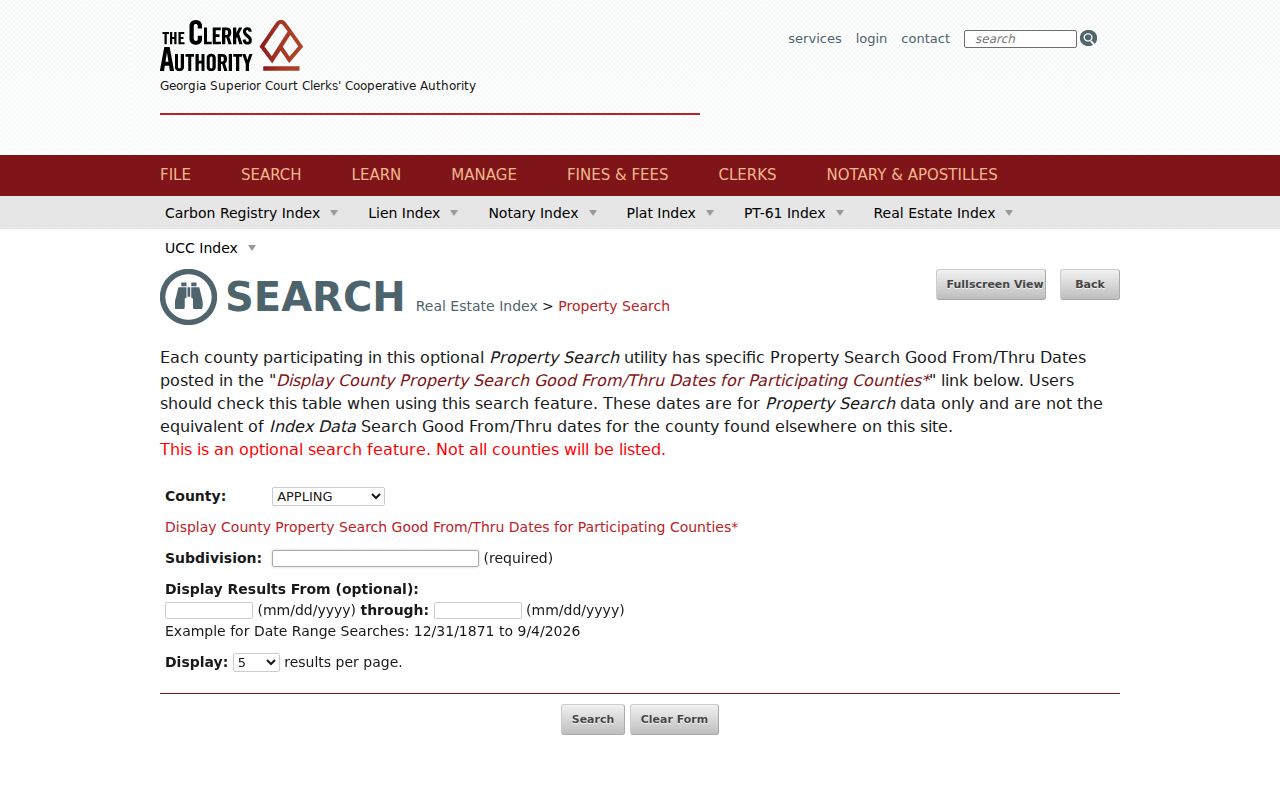
A recorded subdivision name often beats a street address in this index. Street names change; subdivision names tend to stick with the plat. A book and page hit, meanwhile, pins down a citation far more precisely than a name match. A name match can surface a dozen near-duplicates. Whatever mode you use, the final step is the same. Compare the legal description and parcel context before you accept any match as the right deed.
Respect the Oconee Online Coverage Gap
Coverage has limits, and knowing them saves wasted effort. The name screen states a good-from date of January 1, 1990. The landing page describes coverage of all counties since 1999. Data from 1993 to 1998 is still being added. The exact Oconee image cutover is not stated anywhere. So treat an empty online result as a reason to check the Clerk's deed books. It is never proof that no deed exists.
Note: Searchable index dates do not guarantee that every corresponding deed image is available online.
Take the Oconee Chain Into Deed Books
Older Oconee deeds live in more places than the courthouse. The Ivy Room holds deed and mortgage microfilm. It also keeps Superior Court Minutes from 1875 to 1898 and Homestead Records from 1876 to 1912. Georgia Archives county cards point to surviving microfilm and FamilySearch access. Oconee County was created in 1875 with Watkinsville as its seat. Anything earlier may sit in Clarke County records. Archives guidance adds one warning: a courthouse-disaster notation never means everything vanished. Check each surviving series on its own.
Pair Deeds With Plats, Liens and Releases
A deed trail reads best beside its companions. Run the plat index and lien index alongside the deeds. One Bishop-area file shows why: an unapproved 2023 plat was followed by a corrected 2025 administrative plat. That later plat carried a Cemetery Road non-access easement. It materially changes how the tract should be read.
Watch New Oconee Filings Through FANS
You do not have to check the index daily. The statewide Filing Activity Notification System sends voluntary, forward-looking alerts tied to indexed activity. It is the only filing-alert channel available for Oconee. Georgia's title-theft guidance ties FANS to deed-filing safeguards effective January 1, 2025. Remember that alerts depend on clerk index transmission. They validate nothing on their own. When an unfamiliar instrument appears, retrieve it and contact the Clerk through official channels.
Confirm the Tract, Not Just the Party
Names repeat in Oconee County. Entity names change. One owner of record can hold several parcels. That is why confirming the tract matters more than matching the party. Check every deed against the legal description, subdivision, acreage, map code, and any plat reference. A deed may spell out metes and bounds while the appraisal card uses shorthand. So compare distinctive calls, adjoining owners, and book and page references rather than expecting identical wording.
The county Road Book helps decode references along the way. Its key covers abbreviations including CR# for county road and PE for prescriptive easement. It also includes RW for right of way, PB for plat book and page, and S/D for subdivision. The county warns that the Road Book is not a legal document. It also cautions that right-of-way details may be inaccurate. Treat it as an index that leads back to recorded plats, deeds, and surveys.
Handle Estate and Court Transfers Carefully
Not every transfer is a simple sale between buyer and seller. An executor or administrator deed may rest on an Oconee Probate Court estate file. A quiet-title, partition, or foreclosure fight may leave a Superior Court trail. The Probate Court handles estate proceedings, though staff cannot give legal advice. The local docket search can identify a case. The clerk can then provide the filed record or the certification route. These proceedings interrupt an ordinary chain. Record the authority named in the deed. Locate the related case when needed. Keep going through later corrective deeds, releases, or orders. A tax deed or sheriff's deed reflects a process rather than a voluntary sale. It may deserve legal review before you draw conclusions about present title.